REVIEW · VENICE
Venice: Entrance Ticket to the Naval Historical Museum
Book on GetYourGuide →Operated by D'Uva · Bookable on GetYourGuide
Venice’s naval past has a good home. The Naval Historical Museum of Venice (MUNAV) is one of Italy’s most important maritime stops, and it’s tucked just a short walk from Piazza San Marco near the Ancient Arsenal. You’ll move through a 15th-century Granary building and work your way across five floors of ships, models, paintings, and documents.
I especially like two things: the sweep from ancient Venetian boats to modern Italian Navy models, and the standout collection of boats from China and the Far East. One possible drawback: since this is self-guided entry (no guided tour included), you’ll want to be the type who enjoys reading plaques and labels at your own pace.
In This Review
- Key Things I’d Prioritize in MUNAV
- Why MUNAV Fits Venice So Well
- Location: Walkable from Piazza San Marco, Beside the Arsenal
- The 15th-Century Granary Building and What It Changes
- A Practical 90-Minute Route Through the Museum
- Start at the Maritime Foundations
- Follow the Thread Into Ship Models and Artifacts
- Use the Paintings and Documents to Put the Ships in Context
- Don’t Miss the Museum’s Far East Highlight
- Finish with the Modern Italian Navy Models
- What Makes the Collection Worth Your Time (Even Without a Guide)
- Ticket Value: Is $18 Worth 1.5 Hours?
- Ownership and Management: Why It Feels Different
- Who Should Book This Entrance Ticket
- Practical Tips So Your Visit Feels Complete
- Plan your 90 minutes as a route, not a race
- Prioritize the Far East boats if you like variety
- If you’re bringing a small pet, follow the rules
- Use the separate entrance to protect your time
- Should You Book MUNAV Entrance Tickets?
- FAQ
- Where is the Naval Historical Museum of Venice (MUNAV) located?
- How much is the entrance ticket?
- How long does the visit take?
- What is included with the ticket?
- Is a guided tour included?
- Can I skip the line?
- Are small pets allowed inside?
- Can I reserve and pay later?
- What is the cancellation policy?
- Who owns and manages MUNAV?
Key Things I’d Prioritize in MUNAV
- Five-floor museum in a former Granary: a historic setting that makes the artifacts feel grounded in real shipyard-era Venice.
- Ship models + paintings + documents: not just objects, but context for how Venice thought about power at sea.
- Ancient-to-modern naval timeline: you can connect early Venetian maritime strength to the Italian Navy of today.
- China and Far East boat collection: a rare focus that adds variety beyond standard European maritime themes.
- Owned/managed through Italy’s defense institutions: the tone tends to be practical and official, not purely decorative.
- Separate-entrance skip-the-line entry: saves time so you can spend your 1.5 hours actually looking.
Why MUNAV Fits Venice So Well
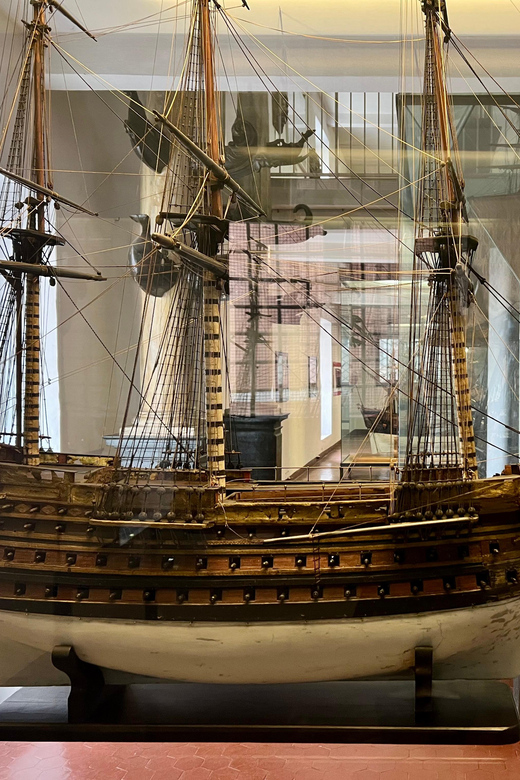
If your Venice plans lean “real city life” over postcard loops, MUNAV is a strong choice. This museum is built around a single theme that mattered to Venice for centuries: getting goods, people, and influence across water. You’re not stuck with just a few famous rooms. The museum covers a wide stretch of maritime time, from Venice’s early boat culture to modern Italian Navy models.
I also like the fact that the museum isn’t trying to be flashy. Instead, it feels like a working archive turned into a public museum. That’s a win if you care about detail—ship design, historical documentation, and how maritime stories were preserved.
A few more Venice tours and experiences worth a look



Location: Walkable from Piazza San Marco, Beside the Arsenal
You don’t need a complicated route. MUNAV sits about a 5-minute walk from Piazza San Marco, and it’s adjacent to the Ancient Arsenal of Venice. That placement matters because it helps your visit “click.”
Before you even enter, you’ll be in the area where Venice’s shipbuilding identity lived. If you’re planning a day that includes the Arsenal area, this museum becomes an easy add-on that feels connected rather than random.
The 15th-Century Granary Building and What It Changes
MUNAV is housed in a 15th-century building that once served as the Granary of the Serenissima Republic. That’s not trivia for trivia’s sake. A granary was about storage, logistics, and systems. Maritime Venice ran on systems—what to build, what to store, and how to move everything when fleets were ready.
Inside, the museum spans 6,000 square meters and spreads its exhibitions across five floors. For you, that means two things:
1) You’re going to have enough space to slow down and actually read.
2) It’s easy to wander too long unless you set a mental loop for your 1.5-hour visit.
A Practical 90-Minute Route Through the Museum
There’s no strict “tour script” here, since your entry ticket is self-guided. But you can still structure your time. With 1.5 hours, I suggest thinking in zones rather than trying to see every label.
Start at the Maritime Foundations
Your first stop should be the areas that cover the origins of Venice’s naval tradition. Expect exhibits that connect the city’s early maritime world with later development. This is where the museum’s theme becomes clear: Venice didn’t just build ships. It built knowledge—boats, documents, and systems around water.
You can also read our reviews of more historical tours in Venice

Follow the Thread Into Ship Models and Artifacts
Next, shift toward the displays featuring historical artifacts, ship models, paintings, and documents. This is the part where models do real work. A small model can explain shape, scale, and design choices faster than a long text-only exhibit.
The useful angle here is that you’ll be able to compare. Even without a guide, you can track how the museum presents naval evolution as something you can see.
Use the Paintings and Documents to Put the Ships in Context
Ship design is one story. Paintings and documents add the other story: why these boats mattered and how people recorded the naval world. If you tend to skip text sections in museums, don’t do that here. The documents and paintings are a big part of what makes the visit feel like more than a display case.
A good rule for your pace: if you’re going to read only one section, read the ones tied to documents and official records—those are where the museum usually signals what it wants you to understand.
Don’t Miss the Museum’s Far East Highlight
One of the most distinctive parts of MUNAV is its exceptional collection of boats from China and the Far East. This is the contrast that helps the museum feel bigger than just “Venice builds boats, Venice wins.”
For many people, this collection is the surprise. It broadens your sense of maritime connections. Even if you’re not an expert on naval architecture, you’ll likely notice the museum is comparing ideas across regions, not just listing ships.
Finish with the Modern Italian Navy Models
Close your visit by looking at the exhibits reaching into the modern Italian Navy era. Doing this at the end helps your brain build a timeline. You’ll see the arc from early Venetian maritime identity to present-day naval models under Italy’s armed forces framework.
If you’re short on time, prioritize this finish. Modern models often help you understand why the museum still matters today.
What Makes the Collection Worth Your Time (Even Without a Guide)
This entry ticket includes admission, not a guided tour. That might sound like a limitation. For the right visitor, it’s actually a benefit.
Without a guide, you control the pace. With five floors to choose from, some people enjoy reading slowly while others want quick scans. The museum supports both. The structure—artifacts, ship models, paintings, and documents—means you can focus on what catches your interest and still feel you got the full message.
Two practical advantages:
- Ship models help you see what you’d otherwise miss in photos.
- Documents and paintings turn “boats” into “systems and decisions.”
One small caution: if you hate reading museum labels or you need someone to explain everything out loud, you might feel a bit under-supported. In that case, you may want to pair your visit with additional on-site reading time before or after.
Ticket Value: Is $18 Worth 1.5 Hours?
For $18 per person, you’re paying for more than a single room. You’re buying access to a substantial museum space—6,000 square meters—with a five-floor exhibition and a full theme spanning ancient to modern naval periods.
Here’s how I think about value for MUNAV:
- If you like maritime topics, models, and archival-style exhibits, the price-to-time ratio is very fair. You’re not just paying to say you visited a museum near San Marco.
- If you only want one or two highlights (like just the Far East boats), you can still get value, but you’ll want to move efficiently through the rest of the displays.
Also, your time isn’t wasted at the door. The activity includes a skip-the-line through a separate entrance, which helps protect your 1.5-hour window for actual viewing.
Ownership and Management: Why It Feels Different
MUNAV is owned by the Italian Navy and managed by the Ministry of Defense. The museum is also described as preserved and promoted through the armed forces’ institutions and culture.
What does that mean for your experience? It often comes through as an official, structured tone. Instead of a purely entertainment-focused narrative, the museum tends to emphasize preservation, documentation, and the identity of naval service. For many visitors, that creates a museum that feels serious in a good way—less show, more substance.
Who Should Book This Entrance Ticket
This is a great fit if you:
- like ship models, maritime artifacts, and the “how it worked” side of history
- want a Venice activity that’s different from churches and canals
- enjoy self-guided museum visits and don’t need an audio script to stay engaged
It may be less ideal if you:
- strongly prefer guided tours with interpretation
- want something mostly visual without reading
- have very limited time and want a faster “grab-and-go” stop
Practical Tips So Your Visit Feels Complete
Here are a few smart moves that match how MUNAV is set up.
Plan your 90 minutes as a route, not a race
With five floors, your biggest risk is ending up in the wrong order and running out of time before the parts you care about most. Decide early that you’ll aim to cover foundations first, then artifacts/models/documents, then finish with the modern naval displays.
Prioritize the Far East boats if you like variety
If you want something you won’t see in every European maritime museum, make the Far East collection a priority. Even if you skim other parts, try not to skim that.
If you’re bringing a small pet, follow the rules
Small pets are allowed in the rooms and outdoor spaces if they’re carried in their own carrier or in arms for the duration of the visit. Guide dogs are exempt from this rule.
Use the separate entrance to protect your time
Since skip-the-line entry is included via a separate entrance, take advantage of it. It’s one of the best ways to make sure you actually enjoy the museum instead of spending your 1.5 hours waiting.
Should You Book MUNAV Entrance Tickets?
I’d book this ticket if you want a Venice experience anchored in maritime identity and you’re comfortable doing it at your own pace. For $18, you get admission to a substantial, multi-floor museum with artifacts, ship models, paintings, and documents, plus a standout focus on boats from China and the Far East. Add the nearby Arsenal setting and the separate-entrance skip-the-line entry, and it’s a solid use of 90 minutes.
Skip it or pair it with something else if you expect a guided-style walkthrough. This is best when you’re the type who enjoys reading, comparing objects, and building your own maritime timeline as you go.
FAQ
Where is the Naval Historical Museum of Venice (MUNAV) located?
It’s about a 5-minute walk from Piazza San Marco and adjacent to the Ancient Arsenal of Venice.
How much is the entrance ticket?
The price is $18 per person.
How long does the visit take?
The duration is listed as 1.5 hours.
What is included with the ticket?
Your ticket includes entry to the museum.
Is a guided tour included?
No. A guided tour is not included.
Can I skip the line?
Yes. You get skip-the-line entry through a separate entrance.
Are small pets allowed inside?
Access to the rooms and outdoor spaces is permitted with small pets if they are carried in their own carrier or in arms for the duration of the visit. Guide dogs are exempt from the rule.
Can I reserve and pay later?
Yes. The offer includes reserve now & pay later, so you can book your spot and pay nothing today.
What is the cancellation policy?
You can cancel up to 24 hours in advance for a full refund.
Who owns and manages MUNAV?
The museum is associated with the Italian Navy and is managed under the Ministry of Defense (with the Navy managing it).