REVIEW · SOUTH BRAZIL
Official Ticket: Oceanographic Museum Univali – Piçarras – SC
Book on Viator →Operated by Museu Oceanográfico Univali · Bookable on Viator
Sea life comes with serious science. In Piçarras, at the Univali Oceanographic Museum, you move through seven themed wings and a big outdoor panel, all focused on Brazilian marine biodiversity. It’s a smart mix of fossils, skeletons, and tanks that helps you connect the dots between habitats and species.
Two things I like right away: the touch experience included with admission, and the way the museum links facts across sections. In the shark and ray wing, you’ll find a jaw display described as the only white shark jaw in Brazil, plus aquariums tied to different habitats.
One possible drawback: some rooms can feel dim, and a few label areas don’t go as far into explanations as you might want, so slow down and read what you can.
In This Review
- Key Highlights
- Where It Is and When to Go in Piçarras
- Seven Themed Wings: How the Museum Keeps You Oriented
- Blue Wing: Fossils, Oceanography, and the Story of Life
- Red Wing: Invertebrates Up Close (Corals, Squid, Echinoderms)
- Green Wing: Sharks and Rays, Including Reproduction and a White Shark Jaw
- Brown Wing: Bony Fish, Deep-Sea Oddities, and Real Habitat Variety
- Gray Wing: Sea Turtles and Marine Reptiles in Brazil
- Beige Wing: Penguins, Seabirds, and a Diorama of the Wandering Albatross
- Black Wing: Dolphins, Whales, Whaling History, and More Marine Mammals
- Ocean Giants Panel Outside: The Blue Whale at Full Scale
- The Touch Experience: What You Gain, and Why Some People Disagree
- Price and Value: Is US$15.68 Worth It?
- How Long to Plan and How to Make the Most of It
- Who Should Book This Ticket
- Should You Book This Museum Ticket?
- FAQ
- What’s the duration of the Oceanographic Museum Univali visit?
- What’s included with the ticket?
- What’s the price per person?
- When is the museum open?
- Is cancellation free?
- Are service animals allowed?
- Can most travelers participate?
Key Highlights
- A sensory touch experience included that turns “reading” into hands-on learning
- Seven-wing layout that keeps the exhibit organized by theme instead of random rooms
- The shark and ray section featuring Brazil’s only white shark jaw display
- Marine reptiles focused heavily on sea turtles, including Brazil’s five turtle species
- Deep-sea storytelling, including a rare exhibit of fish living over 2,000 meters down
- The Ocean Giants outdoor panel, with a full-scale blue whale at 33 meters and 170 tons
Where It Is and When to Go in Piçarras
The Oceanographic Museum Univali sits in Piçarras, on Brazil’s south coast (Santa Catarina state). The visit window is very afternoon-friendly: Tuesday through Sunday, from 2:00 PM to 5:30 PM. The ticket experience is usually about 1 hour to 1 hour 30 minutes, so it’s easy to fit into a beach-and-dinner day.
Timing matters because the museum closes in the early evening. If you’re traveling with kids or you want time to read slowly, plan to arrive near opening so you don’t feel rushed.
Seven Themed Wings: How the Museum Keeps You Oriented
The biggest advantage here is structure. The exhibition is divided into seven wings, each with a clear focus, plus an outdoor panel for scale. Instead of bouncing between unrelated displays, you build understanding step-by-step: ancient ocean science first, then animals by group, then ecology and human history.
As you walk, you’ll see a repeating rhythm: big objects (fossils or skeletons), then explanation panels, then aquariums with live specimens. That pattern helps you remember what you’re looking at and why it matters.
Blue Wing: Fossils, Oceanography, and the Story of Life
Start in the Blue Wing, which sets the stage with the emergence of life and oceanography. You’ll see fossils from different geological ages, so the ocean isn’t treated like a “today-only” world. The wing also connects the sea to how humans thought about it long ago, including references to exploration and the people who advanced oceanographic study.
What I like about this section is how it frames everything else. When you later meet sharks, turtles, and seabirds, you’re not just collecting species names. You’re seeing how ocean science and ocean history feed into what people understand about marine life now.
Red Wing: Invertebrates Up Close (Corals, Squid, Echinoderms)
The Red Wing focuses on marine invertebrates, and it’s a great palate cleanser after the fossil-heavy beginning. You’ll find calcareous skeletons in front of aquariums where animals of the same types are presented alive. It’s a simple but effective teaching idea: form before movement, then movement makes the form make sense.
Highlights include mollusks shown through shells and specimens (including whole preserved giant squid), plus echinoderms such as sea stars and sea urchins. The wing ends with crustaceans like shrimp and crabs, which tend to feel more “alive” even in static displays because of the shapes and colors.
A practical tip: if you’re going quickly, don’t skip the front-of-aquarium skeleton displays. They’re the quickest way to understand what you’re seeing in the tanks.
Green Wing: Sharks and Rays, Including Reproduction and a White Shark Jaw
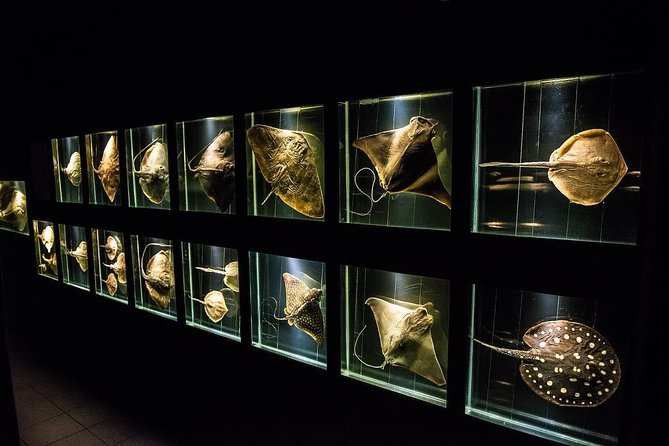
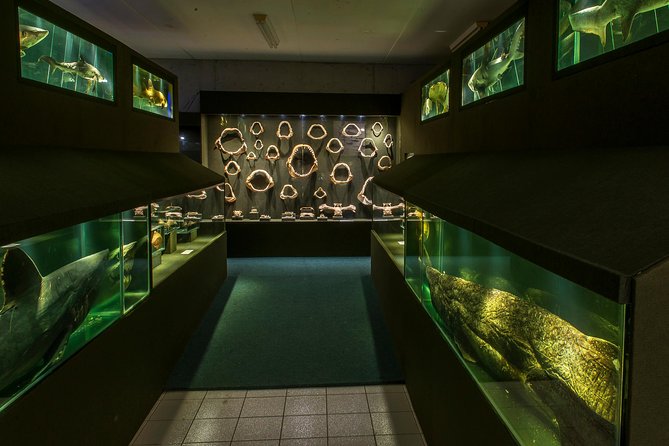
Next comes the Green Wing, dedicated to cartilaginous fish. Expect a wide range of sharks and rays, including coastal, deep-sea, and endangered animals. One of the standout items is the display of teeth and jaws, including the only white shark jaw on display in Brazil (as described by the museum).
This wing doesn’t just focus on “scary faces.” It also includes a sector on reproduction, showing how these animals adapt to different marine habitats. Four aquariums complete the picture by representing different wild habitats, which helps you connect species to where they live instead of treating them like random specimens.
If you care about marine biology basics, this is one of the places to slow down. You’ll get the most “how it works” feeling here.
Brown Wing: Bony Fish, Deep-Sea Oddities, and Real Habitat Variety
The Brown Wing shifts to bone fish and shows the range of bony fish families with different shapes and adaptations. You’ll see large representatives such as tarpon (including a primitive and coastal type) and swordfish. There’s also an aquarium component that includes fish from the Indian Ocean and the Pacific Ocean, which broadens the exhibit beyond just local waters.
One of the rarer-feeling parts of the museum is the mention of a deep-sea fish exhibit living in abyssal areas over 2,000 meters deep. Even if you don’t catch every species name, knowing the “over 2,000 meters” angle helps you appreciate how different life can be in low-light zones.
This wing is a strong choice if you like variety and visual differences between fish body shapes.
Gray Wing: Sea Turtles and Marine Reptiles in Brazil
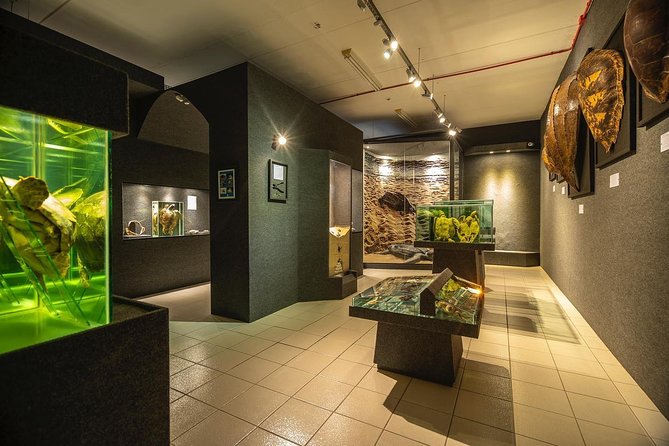
In the Gray Wing, marine reptiles take center stage. The museum notes marine reptiles are limited to 14 species overall in the collection, and the collection is mostly sea turtles. In Brazil, there are five turtle species, and all are presented here.
This wing is designed to show biology and ecology, from small “juvenile” sizes up to giant sea turtles. I like that the museum treats turtles as ecological players, not just as cute icons. The more you read, the more you start thinking about how feeding, habitats, and life cycles connect.
If you’re visiting with kids, turtles are often a fast favorite. If you’re visiting for education, this wing rewards attention because it’s more than a photo wall.
Beige Wing: Penguins, Seabirds, and a Diorama of the Wandering Albatross
The Beige Wing focuses on seabirds, and it includes penguins from around the southern hemisphere. The exhibit presents all species of penguins and highlights their distribution across southern waters.
The highlight is a diorama representing an oceanic island tied to endangered wandering albatrosses. Dioramas can feel like “just a model,” but in this case it’s useful because it gives you a visual habitat map. You can picture the nesting environment, not only the bird itself.
Black Wing: Dolphins, Whales, Whaling History, and More Marine Mammals
The Black Wing covers marine mammals, and it starts with a historical section on whaling and commercial exploitation. The museum specifically notes whaling was widely practiced in Santa Catarina, so it connects the ocean topic to a local human history angle.
After the history comes the modern animals: dolphin and whale species that occur in southern Brazil, with notes on biology. The wing also includes South American wolves and sea lions, and manatees that occur in northeastern Brazil.
This wing can feel heavier than the others because it includes exploitation history. But it’s also where the exhibit becomes more “real world,” connecting marine life to human impact. If you’re sensitive to that theme, it’s good to know you’ll hit it early in the wing.
Ocean Giants Panel Outside: The Blue Whale at Full Scale
Don’t rush past the outdoor Ocean Giants Panel. It features the largest marine animals of each group on a full-scale presentation. The standout detail is the blue whale: 33 meters long and 170 tons.
This is the kind of display that improves your “mental scale.” After standing next to something meant to be that size, the rest of the museum’s animals feel more grounded. You start thinking about how enormous these creatures are relative to people and boats.
The Touch Experience: What You Gain, and Why Some People Disagree
The ticket includes access to the exhibition and a sensory experience with marine animals. In practice, that often translates to a touch-style activity space, and the experience is praised as especially memorable for kids and adults who learn best through contact.
At the same time, not everyone rates it equally. Some visitors feel the touch lab doesn’t justify the cost or doesn’t add much compared with the rest of the exhibits. I’d treat it as a bonus, not the main reason to go—because the museum’s big value is still the animals, the wings, and the themed structure.
If you’re traveling with children, though, the odds are good that the touch experience will be a highlight. Plan to use that time to slow down and ask yourself what you’re feeling compared with what you saw in shells and skeletons.
Price and Value: Is US$15.68 Worth It?
At about US$15.68 per person, the museum is priced in the “reasonable day activity” range. For me, the value comes from two things. First, you’re paying for a full exhibition route that typically lasts up to about 90 minutes. Second, you get variety across many animal groups, not just one small aquarium corner.
This is best value if you enjoy marine biodiversity and want a structured education walk. If your goal is a quick stop to see a couple of tanks, you may feel the time and ticket cost don’t match what you personally care about—especially if your biggest interest is only the touch lab.
For a family, couples, or anyone who likes learning without a heavy academic tone, it’s a solid deal.
How Long to Plan and How to Make the Most of It
Plan for 1 to 1.5 hours. If you read labels carefully, aim closer to 90 minutes. If you skim, you can likely finish quicker, but the museum’s teaching structure works best when you move at a steady pace.
Because some areas can be dim, don’t treat the visit like a sprint with your phone camera. Bring a bit of patience for reading and compare what you see in fossils or skeletons to what you see in aquariums. That matching is the “secret sauce” of this museum.
Also, since the museum is open only from the afternoon, build your day around it. You’ll enjoy it more if you aren’t rushing from a long commute or trying to cram five things before dinner.
Who Should Book This Ticket
This is a good match for:
- Families with kids who enjoy live animals and hands-on experiences
- Marine life fans who like sharks, turtles, penguins, and bird-themed exhibits
- People who want an organized education route that stays under two hours
It’s a weaker match if:
- You only want the touch experience and expect that to be the biggest focus
- You dislike museums where lighting or label detail can vary by room
Should You Book This Museum Ticket?
I’d book it if you want a structured, animal-focused museum visit in Piçarras. The wings make it easy to follow, and the standout items—like the white shark jaw display, the turtle lineup, and the Ocean Giants blue whale—give you memorable moments that you can’t easily recreate elsewhere.
If you’re short on time or you’re not that interested in marine biodiversity, you might find better bang elsewhere. But for the price and the variety, this ticket is a smart bet for a calm afternoon that teaches you a lot without feeling like school.
FAQ
What’s the duration of the Oceanographic Museum Univali visit?
The experience typically lasts about 1 hour to 1 hour 30 minutes.
What’s included with the ticket?
Admission includes access to the exhibition and a sensory experience with marine animals.
What’s the price per person?
The official ticket price is US$15.68 per person.
When is the museum open?
The museum is open Tuesday to Sunday, 2:00 PM to 5:30 PM during the listed period.
Is cancellation free?
Yes. You can cancel for a full refund up to 24 hours before the experience start time.
Are service animals allowed?
Yes, service animals are allowed.
Can most travelers participate?
The experience notes that most travelers can participate.