REVIEW · NAPLES
Naples: City and Lapis Museum Tour with an Archaeologist
Book on GetYourGuide →Operated by Grand Tour Experience · Bookable on GetYourGuide
Naples has a second city underground. This tour makes it real by guiding you through Greek cisterns, Roman water routes, and WWII air shelters, and you do it with an archaeologist who can explain how all those layers fit together. One heads-up: the route is steep and enclosed, and it is not suitable for wheelchair users.
I also like how the experience starts at street level—Piazza San Gaetano and Via dei Tribunali—and builds momentum as you go downward, step by step. It’s a small group (up to 10), so you actually get time for questions and not just a rushed march to the next room.
In This Review
- Key things to know before you go
- Naples underground: how one city hides three eras
- Piazza San Gaetano to Via dei Tribunali: the above-ground warm-up that pays off
- Basilica di San Lorenzo Maggiore and the Church Stops: where the timeline becomes visible
- Going down 40 meters: Santa Maria Maggiore and the Pagan-to-Roman-to-Church story
- Greek cisterns to Roman water tanks: follow the city’s plumbing
- LAPIS Museum path: why this route feels guided, not just accessed
- WWII shelters and 1943: the underground’s survival chapter
- The archaeologist guide: the difference between facts and meaning
- Price and time: is it worth $53 for two hours?
- Who should book this Naples underground tour
- Practical tips that help underground tours actually feel good
- Should you book this Naples City and Lapis Museum Tour with an Archaeologist?
- FAQ
- Where does the tour start?
- Where does the tour end?
- How long is the Naples underground tour?
- How much does it cost?
- What sites are included in the underground part?
- What’s included in the price?
- What languages are the tours offered in?
- Is the tour suitable for wheelchair users?
- What should I bring?
- Are pets allowed?
Key things to know before you go
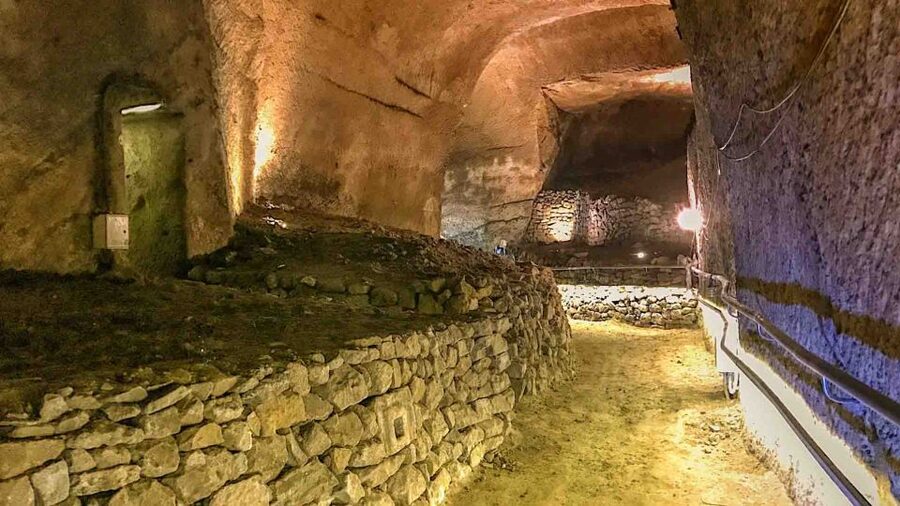
- World’s largest underground path (according to the tour info): you’ll travel between Greek cisterns, Roman aqueduct areas, and WWII shelters.
- Go 40 meters down: the descent starts through an old doorbell entrance linked to Santa Maria Maggiore.
- You’ll see layered building on building: Roman structures under a later church setting, plus Greek stonework carved into tough material.
- LAPIS Museum is the backbone: the route follows the LAPIS Museum underground path, with guided access included.
- WWII connection isn’t just a story: the trail includes WWII-era shelter spaces used in 1943.
- Small-group pace: up to 10 people helps keep the tour conversational and easier to follow.
Naples underground: how one city hides three eras
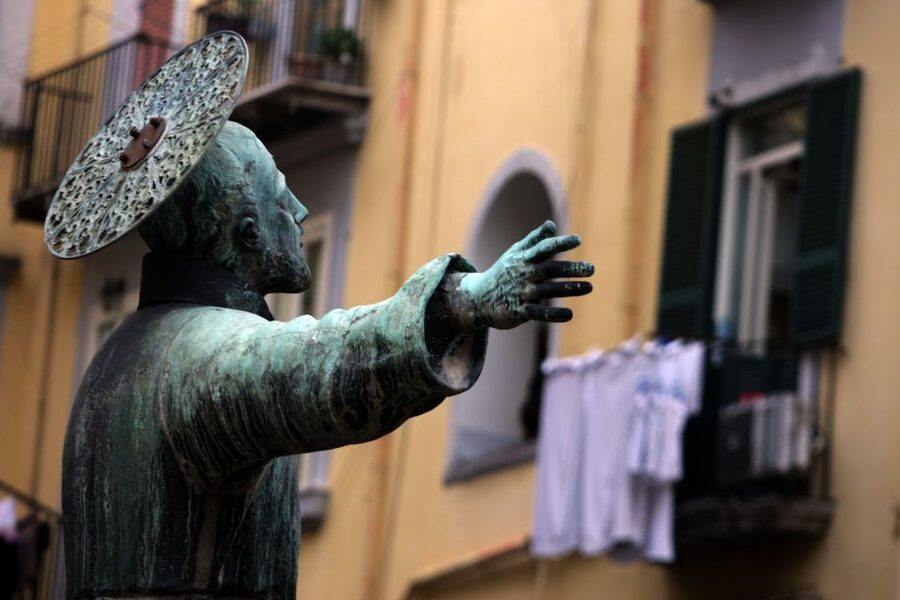
Naples is old in the literal sense: the city keeps rewriting itself on top of earlier eras. What makes this tour special is that you don’t just read about those eras—you walk through the spaces where the eras overlap. You start above ground, then slowly trade street noise for stone corridors, water systems, and wartime shelter rooms.
The underground scale matters here. The tour information says about 45% of Naples’s underground is practically empty, which is a huge clue for why so much survives. You’re not going “to a single attraction.” You’re moving through a long underground route that connects Greek water infrastructure, Roman water-collection thinking, and WWII survival spaces. In two hours, it feels like you’re traveling through the timeline using the city’s own hidden architecture as your map.
And yes, you’ll likely feel the altitude change and the physical shift as you descend. It’s not a theme-park vibe. It’s real stone, real steps, and real darkness—so comfy shoes help a lot.
You can also read our reviews of more tours and experiences in Naples.



Piazza San Gaetano to Via dei Tribunali: the above-ground warm-up that pays off
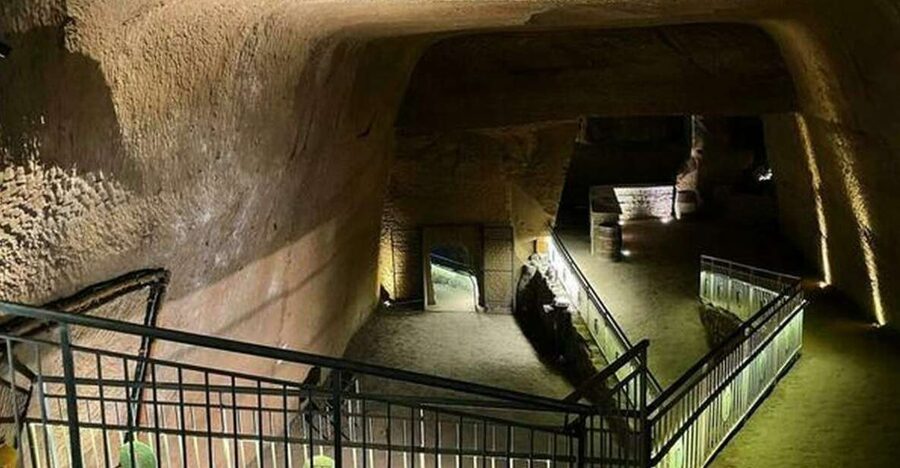
The tour starts at Piazza San Gaetano, at the foot of the statue, with a guide holding a Grand Tour Experience sign. Even before the underground part, you get a setup for what you’re about to see: the guide frames Naples as a layered city, where “up there” explains “down here.”
From there you head along Via dei Tribunali. This matters because it gives you context. Naples doesn’t feel like a museum city above ground—it feels lived-in. You’ll walk through streets and local culture, and that’s what helps the underground stop feeling random. You’re not just touring tunnels. You’re connecting the surface neighborhoods to the underground world underneath.
One practical note: because you’re starting above ground and then dropping under it, wear clothing that works for that transition. The tour info calls for weather-appropriate gear, which is smart advice in Naples when conditions can change quickly.
Basilica di San Lorenzo Maggiore and the Church Stops: where the timeline becomes visible
One of the best parts of this tour is how it uses church architecture to point you toward older origins. The visit to the Basilica di San Lorenzo Maggiore is part of that strategy. You’re not only looking at religious space—you’re getting a clue about how older Roman elements and later religious structures coexist in the same urban footprint.
Then you reach the Church of Purgatory, where you can peer through a glass floor at the remains of an ancient mosaic. That moment is small, but it hits hard: you’re standing in a working church environment, and right beneath your eyes are fragments of something earlier. It’s one of those Naples experiences that trains you to look differently—less “what you see,” more “what came before.”
Some tours rush this kind of stop. This one doesn’t have to, because the real event is below. Still, I like that you’re given visual anchors above ground first, so when you go down later, you already understand you’re chasing layers, not just sightseeing.
Going down 40 meters: Santa Maria Maggiore and the Pagan-to-Roman-to-Church story
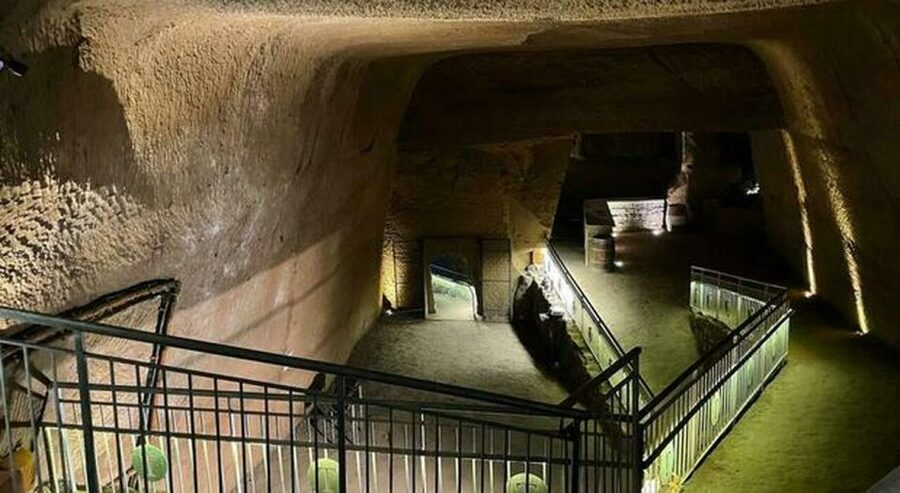
When the tour starts the descent, it does it with a dramatic, physical change. You go 40 meters below the crowds of Naples through a doorbell-style entrance connected to Santa Maria Maggiore.
This is where the tour’s archaeology focus really earns its keep. The church is described as built on a Pagan Roman temple dedicated to Diana, and Roman structures still appear in the setting. That means you’re not only looking at “an old church.” You’re seeing how religious identity and architecture changed over time on the same site.
As you go deeper, the experience shifts again—from story to material. The tour moves you toward the Greek cisterns carved into tough stone. The difference between Greek stonework and later Roman additions is something a good archaeologist guide can help you spot. If you’re the type who likes details (or even if you’re not), you’ll probably enjoy how the guide ties construction choices to real needs like water storage and maintenance.
Greek cisterns to Roman water tanks: follow the city’s plumbing
Down at the cistern level, the tour becomes a practical lesson in infrastructure. The Greek cisterns are carved into the stone, and that carving isn’t decorative. It’s functional: it’s water storage designed to last.
From there, you reach the tanks used for the collection of water in Roman times. The tour info frames this as moving through tunnels to reach those tanks, which makes the underground feel like a working system rather than a random set of chambers.
Why you’ll care: in a city like Naples, it’s easy to think of history as big names and dates. But water systems are the hidden reason cities survive. This tour makes that idea tangible. When you see cisterns and water-collection tanks, you start understanding how Naples could grow and endure.
Also, the underground route isn’t presented as dead-end rooms. It’s a trail you walk through. That makes it easier to keep your bearings and understand how spaces relate to one another.
You can also read our reviews of more museum experiences in Naples



LAPIS Museum path: why this route feels guided, not just accessed
The experience is explicitly routed through the LAPIS Museum path, which helps explain why it flows the way it does. You’re not just getting ticket access and wandering. You get guided movement that connects each architectural and historical stop.
The LAPIS Museum portion also matters because it’s where the archaeological interpretation becomes most concentrated. The guide can connect what you’re seeing—cisterns, tunnels, water tanks, and later re-use—to the larger story of Naples beneath Naples.
If you’re wondering whether an “underground tour” can start to feel repetitive, this is the tour where that concern fades. Each segment changes the era and changes the purpose of the space, so it stays interesting without you having to work for it.
WWII shelters and 1943: the underground’s survival chapter
Here’s the emotional pivot of the tour: the underground spaces weren’t only for ancient water systems. They also became protection during war.
At the lowest point of the route, after you’ve already seen the older infrastructure, you move through tunnels to reach the areas tied to water collection and—later—use as shelter space. The tour description says the trail was also used in medieval times as a secret passage connected to Templar Knights, and then in 1943 as an airplane retreat.
That’s a lot of time jumps, but the guide approach is what makes it coherent. You’re seeing reused infrastructure, which is a theme that fits Naples well: a space gets repurposed because it’s already there, already protected, and already part of the city’s underground movement patterns.
One particularly memorable detail in the tour info: many of the bathrooms, kitchens, and memorabilia are still preserved. That makes it harder for WWII to feel abstract. Instead of talking about war as history, you see the shape of daily survival—what people needed, where they were, and how the underground environment was turned into a refuge.
The archaeologist guide: the difference between facts and meaning
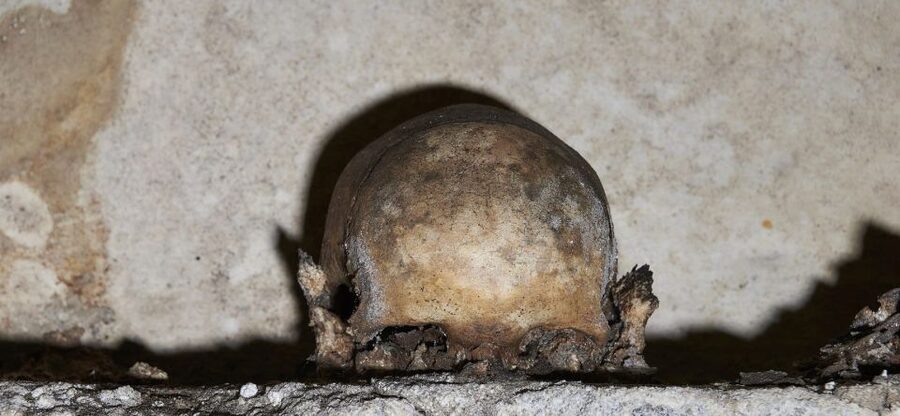
This tour includes a professional archaeologist, and that’s not just a badge. It changes the way the underground feels. With the right guide, stonework stops being anonymous and starts telling you what it was built for and why it looks the way it does.
You’ll likely notice this if your guide is the kind who asks you to look closely rather than just pointing. One review specifically praises Riccardo for being passionate and very knowledgeable in a way that kept time moving fast. Another highlights Theresa for profound expertise and patience with questions. Not every guide experience will be identical, but the pattern is clear: the tour is strongest when the guide can explain clearly and answer follow-ups.
And that small-group format (up to 10) matters here. Underground tours can get noisy, but fewer people means the archaeologist can slow down when you want to understand something. For me, that turns the tour from sightseeing into learning that sticks.
Price and time: is it worth $53 for two hours?
At $53 per person for a two-hour tour, the price can look “mid-range” at first glance. But in value terms, it’s not just a walking tour.
You’re paying for:
- a local guide and a professional archaeologist
- admission tickets tied to the Roman Cistern Museum – LAPIS Museum
- admission tickets tied to WWII Shelters Museum
So you’re essentially combining multiple “things” into one guided experience, and you’re doing it with access to an underground path that’s hard to replicate on your own without knowing where to go. Add in the small-group size and skip-the-line benefit, and the cost starts to make sense.
The main trade-off is time. Two hours is not long enough to linger in every corridor. If you’re the type who always wants an extra 20 minutes in one place, you’ll want to decide where you want to focus—cisterns, Roman sections, or WWII rooms—because the schedule will keep moving.
Who should book this Naples underground tour
This is a great fit if you:
- like history that you can see in physical spaces, not just in photos
- enjoy the connection between daily infrastructure (water) and major events (war)
- want a guide to interpret architecture and reuse across Greek, Roman, medieval, and WWII eras
- prefer small groups so questions don’t get squeezed out
It’s less ideal if you:
- need wheelchair accessibility (it’s not suitable for wheelchair users)
- don’t like enclosed or steep sections
- are expecting a purely surface-and-view tour
If you’re visiting Naples for the first time, this is a strong way to understand the city’s character fast: the surface gives you the setting, then the underground gives you the real story.
Practical tips that help underground tours actually feel good
Comfort matters here more than you might expect.
Bring:
- comfortable shoes for walking on underground surfaces
- a camera if you want photos, but be ready for dimmer lighting underground
- weather-appropriate clothing since you start above ground
- cash and a credit card are mentioned, in case you plan to buy anything nearby
- a packed lunch is listed, which can be useful if you’re planning to keep exploring afterward (since food and drinks aren’t included)
Also plan your pace. Because you’ll go down and then walk through tunnels, take your time when stopping for explanations. It’s tempting to power through, but that’s when the guide’s interpretation becomes the most useful.
Should you book this Naples City and Lapis Museum Tour with an Archaeologist?
My take: if you want Naples to feel like more than just pizza and street corners, this tour is a solid buy. You get a guided underground route that connects Greek cisterns, Roman water tanks, and WWII shelter rooms into one understandable walk, with a professional archaeologist running the story. The small group size also helps you feel included instead of shuffled.
Book it if your schedule allows a two-hour slot and you’re comfortable with a steep, enclosed route. Skip it if mobility limits you or if tunnels and stairs would make the experience stressful.
If you decide to go, come ready to look at stone, water storage, and reused spaces like they’re clues. That mindset is what turns the underground into Naples at full volume.
FAQ
Where does the tour start?
The tour meets at Piazza San Gaetano, at the foot of the statue, where you look for the guide with a Grand Tour Experience sign.
Where does the tour end?
The tour finishes at Piazza Bellini.
How long is the Naples underground tour?
The duration is 2 hours.
How much does it cost?
The price is $53 per person.
What sites are included in the underground part?
You’ll visit the Roman Cistern Museum LAPIS Museum and also access the WWII Shelters Museum during the tour.
What’s included in the price?
Included are a local guide, a professional archaeologist, admission tickets to LAPIS Museum, and admission tickets to the WWII Shelters Museum.
What languages are the tours offered in?
The live tour guide is available in English and Italian.
Is the tour suitable for wheelchair users?
No, it is not suitable for wheelchair users.
What should I bring?
Bring comfortable shoes, a camera, credit card and cash, packed lunch, and weather-appropriate clothing.
Are pets allowed?
Pets are not allowed (assistance dogs are allowed).