Sofia’s Communist leftovers hit different. I like that this day trip mixes outdoor socialist sculpture with the unforgettable Buzludzha Monument, and I like the simple comfort of door-to-door hotel pickup. You get a guided look at ideology turned into concrete, murals, and stars in the open air—without having to plan the logistics yourself.
The main thing to plan for is the long ride: you’re looking at about 3 hours of driving each way, plus time at a remote mountain site. Food and drinks aren’t included, so you’ll want to handle snacks and timing, especially if weather turns ugly.
In This Review
- Key highlights to know before you go
- Price and logistics: where the $108.43 really goes
- Museum of Socialist Art: stars, statues, and Cold War symbolism in plain sight
- Monday switch: Bells Park and the peace project behind the bells
- The long Sofia-to-Buzludzha drive: why it’s part of the experience
- Buzludzha Monument: a socialist UFO that ended up abandoned
- On-site time and what to expect when the building is derelict
- Photos, views, and why the mountain timing matters
- Your guide matters: names you may hear, and how they shape the day
- What to pack for this day: simple items that save your mood
- Who should book this Sofia day trip, and who might skip it
- Should you book BulTrips for Buzludzha and Socialist Art?
- FAQ
- FAQ
- How long is the tour from Sofia to Buzludzha?
- What are the main stops on this day trip?
- What changes on Mondays?
- Is hotel pickup and drop-off included?
- What’s included in the price of $108.43?
- Are food and drinks included?
- What group size should I expect?
- What if the weather is poor?
Key highlights to know before you go
- Museum in a sculpture park with over 70 monumental works spread across 7,500 sq.m
- That big five-pointed star once crowned Sofia’s former Party House
- Monday changes the first stop to Bells Park instead of the Museum of Socialist Art
- Buzludzha admission is free, but the site is still a serious mountain day
- Small-group feel with a cap of 15, and trips often run in very small groups
- English guide + hotel pickup using a private vehicle for round-trip convenience
Price and logistics: where the $108.43 really goes
This trip costs $108.43 per person and is built for one thing: getting you out to Buzludzha without the hassle. That price covers hotel pickup and drop-off, transport by private vehicle, and a professional guide, plus local taxes. It also includes admission to the Museum of Socialist Art, and Buzludzha itself has free admission for this experience.
You should know what you’re not getting: food and drinks are not included. For a day that’s roughly 10 hours long, that’s the one gap you’ll feel if you don’t plan a snack strategy. If you’re the type who gets cranky when you’re hungry, bring something simple with you before you get on the road.
Group size stays reasonable. The maximum is 15 people, and the operator also runs tours only for small groups (up to 7) with the option for private tours. In practice, that means you’re more likely to get real questions answered, not just a lecture overhead.
Pickup is from your accommodation in Sofia, and your day starts at 09:30. The structure is straightforward: one cultural stop, one long drive, then the mountain monument.
You can also read our reviews of more museum experiences in Sofia

Museum of Socialist Art: stars, statues, and Cold War symbolism in plain sight
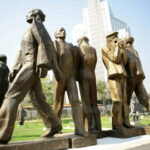
The Museum of Socialist Art is the warm-up act, but it’s not a quick hallway museum. You’re looking at an outdoor park setting with over 70 works of monumental sculpture across 7,500 sq.m. This matters, because you don’t have to imagine the scale—you can walk around it.
One standout piece is the large five-pointed star that once crowned the former Party House in the center of Sofia. In a typical museum, a star like this would feel symbolic. Here, you can see the physical presence of the regime’s branding: huge, heavy, and meant to dominate a skyline.
This stop is scheduled for about 1 hour. That timing works best if you arrive ready to look, not ready to speed-run photos. The guide’s job is to connect what you’re seeing—figures, materials, monumental forms—to what those shapes were trying to communicate.
Comfort note: the park format means you’ll be outside for at least part of the visit. On rainy or cold days, that’s not a dealbreaker, but it does shift your clothing plan. Bring layers you can move in, and shoes you trust on uneven ground.
Monday switch: Bells Park and the peace project behind the bells
If your tour date is a Monday, the Museum of Socialist Art is replaced by the Bells Park. That change isn’t just a swap of scenery—it’s a different kind of socialist messaging.
Bells Park was constructed in 1979 by the daughter of the last Communist leader of Bulgaria. The idea ties to a program called The flag of peace, with children meeting from both sides of the Iron Curtain to make bells that are presented in the park.
This makes the emotional tone shift. Instead of the heavy monumental style, you get a more human Cold War moment: kids connecting through a small craft object—bells. It’s the kind of detail that helps you understand the era without getting stuck in black-and-white stereotypes.
The timing for this stop still stays around 1 hour. That’s enough time to walk the grounds, see how the installation is arranged, and take in what the bells symbolize at ground level.
The long Sofia-to-Buzludzha drive: why it’s part of the experience
You’ll spend around 3 hours driving to reach Buzludzha, and then about 3 hours back to Sofia. That’s a commitment, and it’s also the reason this day trip feels like more than just a single photo stop.
Use the ride time. Looking out the window helps you understand how remote the monument is, and why it became hard to maintain after 1989. The drive also gives you a buffer for weather—rain, clouds, and even snow can shift mountain conditions, and being on the road early helps.
Real talk: the drive can feel long if you’re only expecting a short cultural visit. But if you treat it like a guided countryside transfer—with history in the background—it stops being a chore.
One practical tip: be ready for a day where the site weather may not match the city. The mountain sits in its own world, and conditions can change fast.
Buzludzha Monument: a socialist UFO that ended up abandoned
Buzludzha is the reason most people take this trip, and it’s easy to see why. The monument is one of the most notable socialist-period sites in Bulgaria, and it has a style that fans of brutalist architecture describe as almost sci-fi.
It was erected in 1981 to commemorate socialism. Work began in 1974, and it wasn’t a small project: Bulgarian Army units handled the build, with many artisans contributing large statues and murals. That production scale helps you appreciate it as more than a curiosity. This was meant to be a major public statement.
After the government fell from power in 1989, the site was abandoned and left vulnerable to vandalism. That’s the key contrast you’ll feel when you arrive: the monument’s design is grand and deliberate, but its current state carries the consequences of neglect.
Admission here is free for this experience. That makes the value equation better, because you’re paying mainly for the guide and the transport out to a remote site.
On-site time and what to expect when the building is derelict
You’ll get about 1 hour at Buzludzha. On paper, that seems short, but it’s a realistic slot for walking, looking, and absorbing what’s around you without rushing. The building’s scale can trick you: it looks like one object, but it’s really a complex of rooms, surfaces, and views.
You should also expect some physical effort. The tour asks for a moderate physical fitness level, and the site’s mountain setting can mean cold air, slippery ground, and stairs or uneven paths depending on conditions. If you’re going when it’s snowy or icy, use caution.
One theme that comes up repeatedly with this site is how unreal it feels. People compare it to derelict Soviet spaceships, and the overall vibe is strong: peeling surfaces, dramatic shapes, and the weird calm you get at a place that once aimed to be a destination.
This is also where your guide’s storytelling matters most. A good guide doesn’t just describe what the monument looks like. They connect the materials and design choices to what the era wanted people to feel—then they explain how that message changed once the site was abandoned.
Photos, views, and why the mountain timing matters
Buzludzha sits on a high point, so the views can be a big part of why the trip feels worth it. Even in cloudy or rainy weather, you’re seeing open space around you, and the monument’s silhouette still hits hard.
When the weather is good, you’ll want to take your time with photos because the angles matter. When it’s bad—rain, mist, or snow—you’ll still get great shots, but you’ll likely shoot faster and move carefully. Either way, plan for light that changes quickly on the mountain.
Bring a jacket you can actually wear comfortably while walking. If it’s snowing, you’ll appreciate gloves. The tour data doesn’t promise any special weather handling, but the experience itself is clearly sensitive to conditions.
A small strategic move: if the group is doing a quick photo burst, step away for a moment and let your eyes adjust to the scale. This monument rewards the slow look.
Your guide matters: names you may hear, and how they shape the day
This is a guided tour in English with a professional guide. Guides shape the experience a lot here because both sites are loaded with symbolism, and it helps to have context in real time.
In the operator’s running of the trip, names like Maria and Martin come up. Maria is described as friendly, patient, and accommodating—exactly the kind of guide who can answer follow-up questions without rushing you. Martin shows up as a driver-guide who puts effort into making the day run smoothly, especially when the group situation is unusual.
One practical point: the plan can adjust. On some dates, the first stop may be swapped due to access or closure. In one case, the guide adapted by visiting Thracian tombs instead when the Museum of Communist Arts was closed. On Monday, the museum plan already has a built-in switch to Bells Park.
So if you’re someone who hates rigid schedules, this flexibility is a plus. If you’re someone who only wants the exact two stops, mentally accept there may be one change depending on the day.
What to pack for this day: simple items that save your mood
You don’t need special gear, but you do need the basics for a long, outdoor-heavy day.
Bring:
- A warm layer and a rain layer. The sites are outdoors, and the mountain can be colder than Sofia.
- Comfortable walking shoes. Derelict sites can have uneven ground.
- Snacks and water since food and drinks aren’t included. This is the main thing missing from the package.
- A charged phone or camera battery. The drive and views are part of the experience, not just the monuments.
If you’re traveling with kids, remember children must be accompanied by an adult. The moderate physical fitness note also matters more with younger legs.
The tour is said to have near public transportation, but you shouldn’t plan on using that as your main strategy. The point is the hotel pickup and private vehicle.
Who should book this Sofia day trip, and who might skip it
I think this is a great match if you enjoy architecture, history with real-world visuals, and the odd corners of Europe that don’t feel polished for tourists. You’ll like it if you want something more distinctive than churches and old town squares.
It also fits people who want a guided explanation without having to research details on your own. The combination of a sculpture park and a massive derelict monument is rare for a single day from Sofia.
You might want to skip or reconsider if:
- you’re not comfortable with long driving days (about 3 hours each way),
- you hate outdoor walking in variable weather, or
- you strongly prefer food included as part of the tour price.
This isn’t a slow, leisurely stroll-only trip. It’s a focused, culture-and-architecture day with a mountain component.
Should you book BulTrips for Buzludzha and Socialist Art?
If you’re choosing between a simple Sofia sightseeing loop and a more unusual day trip, I’d pick this one. The value is in the door-to-door convenience, the included guide, and the fact that you’re transported to a site that’s hard to reach on your own.
The best reason to book is the contrast: a sculpture park that shows socialist symbolism at human walking speed, then a monument that feels like an abandoned mission control center. It’s the kind of day that gives you both context and atmosphere.
Book it if you can handle a long drive and you pack for weather and hunger. If either of those sounds miserable, plan for a different outing. If they sound manageable, this is one of the more memorable ways to spend time outside Sofia.
FAQ
FAQ
How long is the tour from Sofia to Buzludzha?
The tour lasts about 10 hours (approximately), including the driving time to the mountain.
What are the main stops on this day trip?
You’ll visit the Museum of Socialist Art in Sofia and then go to the Buzludzha Monument.
What changes on Mondays?
If your tour day is Monday, the Museum of Socialist Art is replaced with Bells Park.
Is hotel pickup and drop-off included?
Yes. You’re picked up from your accommodation in Sofia and dropped off back at the end.
What’s included in the price of $108.43?
The price includes local taxes, a professional guide, hotel pickup and drop-off, transport by private vehicle, and admission to the attractions (the museum admission is included, and Buzludzha admission is listed as free for the experience).
Are food and drinks included?
No. Food and drinks are not included.
What group size should I expect?
The maximum is 15 travelers. The operator also notes small groups of up to 7 persons, with an option for private tours.
What if the weather is poor?
This experience requires good weather. If it’s canceled due to poor weather, you’ll be offered a different date or a full refund.